

Lots of contradictory information about fats and oils can be overwhelming. What are good and bad fats? Which oils are healthiest for cooking or frying? And which should be avoided? Here’s a little guide for you about fats and what you should know when choosing oils.
Smoke point – does it really matter?
First, don’t be misled by the smoke point of oils. A high smoke point doesn’t mean the oil can’t oxidize and become rancid (toxic) at lower temperatures. It’s not just about the temperature at which your oil starts burning, but also about the structure and stability of the oil when heated. There are three different types of fats in oils: saturated, monounsaturated, and polyunsaturated (including omega-3 and omega-6 fats).
A bit of chemistry behind fats and their stability at high temperatures
Saturated fats are the most stable at high temperatures. From a chemical point of view, a fatty acid is essentially a chain of carbon and hydrogen atoms with an acid group at one end. The number of bonds between carbon and hydrogen determines whether the fatty acid is saturated (with no double bonds), monounsaturated (with one double bond), or polyunsaturated (with multiple double bonds).The more double bonds there are (polyunsaturated fats), the more unstable the fat can become when heated, and potentially more toxic.
So why saturated fats are considered as unhealthy?
Excess of saturated fats may disrupt your cell membrane function. They got bad reputation because of the link with heart diseases. If you look at the bigger picture how cardiovascular diseases are developed, you will see that saturated fats are just tiny bit comparing to other major factors like chronic inflammation, oxidative stress, weight, lack of certain vitamins and much more.
An excess of saturated fats may disrupt cell membrane function. They have gained a bad reputation due to their association with heart diseases. Nevertheless, saturated fats are the safest for cooking and frying. When considering the broader picture of how cardiovascular diseases develop, it becomes clear that saturated fats are just a small factor compared to other major contributors like sugar, chronic inflammation, oxidative stress, weight issues, vitamin C deficiencies, excess calcium and much more
What are the healthiest cooking oils and which should be avoided?
Having said that, we just need to be careful about the type of fat we choose for different purposes, whether it’s for salads, sautéing, cooking, or frying
- Coconut oil is my absolute winner. Butter and palm oil (only if not hydrogenated) are safe for cooking at high temperatures. These are mostly saturated oils.
- Olive oil and avocado oil which are mostly monounsaturated are great for salads and can be used for sautéing at low temperatures too. Generally, you don’t really measure the temperature of your frying pan when you cook, right? Unless it’s in the oven where you can set a certain temperature. Personally, I avoid heating these oils too much and use them only raw for salads or as a topping for cooked or roasted veggies, staying on the safe side. The less exposure to light, oxygen and temperature the better to fully preserve structure and health benefits of the oil.
- Vegetable oils like sunflower oil, flax seed oil, soybean oil, safflower oil and grapeseed oil are mostly polyunsaturated. These are the least stable and worst for cooking. While cooking is one aspect, it’s worth mentioning that vegetable oils are very common in packaged foods and snacks. Polyunsaturated fats like sunflower oil are very sensitive and can turn into harmful trans fats very easily when processed. I’ve been trying to find crisps, for example, without sunflower oil and really struggled, so if you know any good brands, let me know!
Saturated vs unsaturated – how to choose cooking oils?
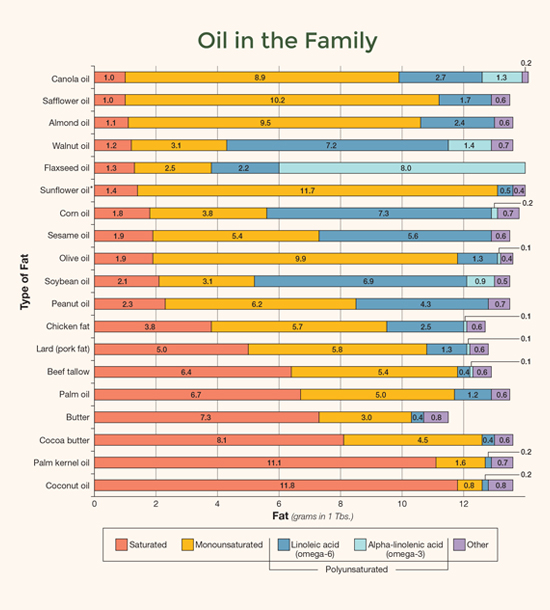
With oils, it’s never black and white. What I mean is that no oil is 100% saturated or 100% unsaturated. Typically, oils contain a mix of three different types of fatty acids. When choosing your oil, just look at the percentage of saturated fat, monounsaturated and polyunsaturated fat it contains.
In general, the more saturated an oil is, the more stable it is and thus most suitable for cooking. Monounsaturated fats come next. They are less stable than saturated fats but still a better choice for heating compared to polyunsaturated fats. The worst choice for cooking would be polyunsaturated oils. I’ve put together this little table with the most common oils, so hopefully, it will help clarify things.
Polyunsaturated fats (omega 3 & omega 6): good or bad?
It’s also worth noting that vegetable oils, which are polyunsaturated fats, are only very harmful when heated. These fats are considered essential fatty acids because your body can’t produce them and they must be obtained through your diet but either from cold press oils or nuts & seeds. Polyunsaturated fats play a key role in making up your cell walls and keeping the cells fluid, allowing more nutrients to enter. In contrast, too much saturated fat can make the cell walls rigid and less fluid. At the end of the day it’s all about balance.
So don’t avoid vegetable oils, just consume them raw (if cold pressed) and store them in cool dark place. Another point to consider is ratio of omega 3 and omega 6 in your diet. The optimal ratio is between 1:2 to 1:4. Nuts, processed meats and most of vegetable oils are high in omega 6. Always make sure you balance high omega 6 intake with omega 3 rich foods like flax seeds, chia seeds, hemp seeds, oily fish (wild salmon, mackerel or sardines). Excess omega 6 relative to omega 3 leads to inflammation and range of symptoms and diseases over time. There is also lots of studies showing that omega 3:6 imbalance is linked with depression and mood disorders.
Toxicity of oils and health implications
What happens when you heat an inappropriate type of oil excessively? The oil becomes oxidized, generating numerous free radicals and harmful compounds like aldehydes. Oxidized or hydrogenated oils are also known as trans fats. Hydrogenation involves converting liquid vegetable oils into a more solid structure so they can be used for various purposes in the food industry (very common in packaged foods and snacks). Oxidized fats disrupt cell membrane function, negatively affect cholesterol profiles and blood vessel function. They are also linked to insulin resistance, poor glucose metabolism and cardiovascular diseases.
2 thoughts on “Healthiest And Most Toxic Oils For Cooking”